Let’s be completely honest with each Haircare other for a second.
You walk down the beauty aisle at your local store or scroll through social media on a lazy Sunday afternoon, and every second bottle is screaming at you. They’re wrapped in soft pastel packaging with pictures of lush green leaves, boasting labels like “100% Raw,” “Clean Beauty,” “Zero-Chemical,” and “Plant-Powered Superfood for Your Hair.”
It sounds dreamy, doesn’t it? It makes you want to throw out everything in your shower, spend eighty bucks on aesthetic glass bottles, and live your best eco-friendly life.
Until you actually bring those bottles home.
You stand in the shower, squeeze out a handful of a very expensive, pine-scented organic concoction, and realize it doesn’t foam up at all. You scrub your scalp until your arms ache, rinse it out, and once your hair dries, you’re left staring in the mirror at a tangled, straw-like nest on top and an itchy, oil-slick scalp on the bottom.
By day three, your head feels so itchy and greasy that you end up reaching for that cheap, five-dollar drugstore shampoo you swore you’d never use again just to feel truly clean.
It is deeply, utterly frustrating.
Somewhere along the line, the “clean beauty” industry convinced us that anything made in a lab by smart scientists is toxic evil, while anything squeezed directly out of a plant in somebody’s backyard is pure magic.
That is complete nonsense.
Poison ivy is 100% natural, raw, and organic, but you wouldn’t rub it into your hair roots, would you?
Switching to a natural or organic haircare routine isn’t about throwing away common sense, nor is it about dumping raw food from your kitchen pantry onto your head every Tuesday. It’s about understanding basic biology: removing harsh, stripping detergents that leave your scalp gasping for air, choosing real plant ingredients that nourish your hair cuticles, and building a low-stress routine that actually fits into your chaotic, busy life.
Here is a ground-level, deeply practical guide to navigating natural and organic haircare in 2026—what actually helps your hair, what is pure marketing garbage, and how to keep your mane looking glorious without turning your bathroom into a chemistry lab.
1. Decoding the Buzzwords: What Are You Actually Buying?

Before you hand over your hard-earned money, we need to strip away the marketing fluff. Brands love using unregulated words because they know those words make you feel warm and fuzzy inside. But what do they actually mean when you turn the bottle around and read the tiny fine print on the back?
                      DECODING THE SHAMPOO BOTTLE

                             PLANT-BASED / NATURAL
                   (Sourced from nature, minimally processed)
                                ╱ ╲
                               ╱   ╲
                              ╱     ╲
                             ╱       ╲
                            ╱         ╲
                  CERTIFIED ORGANIC ──── DERMATOLOGIST TESTED
                  (Farmed without       (Formulated for safety &
                  synthetic pesticides)  scalp compatibility)
“Natural”
In the world of cosmetics, the word “natural” is wildly unregulated in most countries. A brand can take a bottle full of synthetic petroleum byproducts, add half a drop of argan oil at the very end, print a picture of a tree on the front, and call it a “Natural Argan Therapy Shampoo.”
When a reputable brand uses the word correctly, it means the active ingredients are derived directly from plant, mineral, or renewable sources rather than synthetic petrochemicals.
“Organic”
Unlike the word “natural,” the term “organic” actually has legal teeth—if you look for official seal certifications. True organic haircare uses ingredients grown without synthetic pesticides, chemical fertilizers, or genetically modified organisms (GMOs).
If a bottle says “Made with Organic Ingredients,” turn it over. Look for certified seals like USDA Organic, COSMOS Organic, or ECOCERT. If there’s no seal, it’s usually just marketing bravado.
“Clean & Chemical-Free”
This is my absolute biggest pet peeve in the modern beauty world. Everything is a chemical. Water is a chemical ($H_2O$). Air is a mixture of chemicals. Botanical rosewater is a chemical compound.
When brands advertise “Chemical-Free,” they are playing on your anxieties. What they usually mean is “formulated without harsh sulfates, artificial parabens, synthetic phthalates, or heavy silicones.” Don’t fall for the fear-mongering; just look at what’s actually in the formula.
2. The “Is My Hair Actually Liking This?” Reality Check
Let’s do a quick reality check on the viral natural ingredients everyone keeps talking about online. Just because a remedy worked for a influencer with a totally different hair texture living in a completely different climate doesn’t mean it’s going to work for you.
| Ingredient | The Marketing Hype | The Real-World Reality Check | Best Suited For |
| Raw Coconut Oil | “The ultimate cure-all for every single hair problem on earth!” | Incredible for thick, coarse hair, but heavy use on fine or low-porosity hair leads to protein buildup, making hair stiff and brittle. | Thick, coarse, or heavily damaged, high-porosity hair |
| Rosemary Essential Oil | “Grows your hair back overnight like a magic potion!” | Genuinely helps stimulate scalp circulation over several months, but applying undiluted essential oil WILL irritate or burn your scalp skin. | Gentle scalp massages (when mixed into a carrier oil like Jojoba) |
| Pure Aloe Vera Gel | “Instant moisture overload for dry, dead hair!” | Very lightweight and soothing for an inflamed scalp, but acts as a humectant. If you live in a bone-dry climate, it can pull moisture OUT of your hair. | Soothing itchy scalps & light curl hydration in humid air |
| Raw Apple Cider Vinegar | “Replaces your shampoo forever and makes hair shine!” | Excellent for clearing away hard water mineral buildup, but overusing raw acid destroys your scalp’s protective barrier and leaves ends brittle. | Occasional monthly clarifying rinse (diluted 1 part ACV to 8 parts water) |
| Argan & Jojoba Oils | “Gives you glass-hair shine with zero weight!” | Jojoba oil is chemically almost identical to your scalp’s natural sebum. It seals the hair shaft beautifully without creating a gross grease layer. | Smoothing frizzy ends, flying hairs, and daily shine |
3. How Your Hair Actually Works (Without the Boring Science Lesson)
To understand why natural products behave the way they do, you only need to know two basic parts of your hair: The Scalp and The Shaft.
                  THE HAIR STRUCTURE (THE REAL DEAL)

                   [ THE SCALP (Living Skin) ]
                   • Produces Sebum (Natural Oil)
                   • Needs Gentle Cleansing & Air
                   • Thrives at pH ~5.5 (Slightly Acidic)
                                │
                                │  Hair Grows Outward
                                ▼
                   [ THE SHAFT (Dead Tissue) ]
                   • Made of Keratin Protein
                   • Covered in Shingle-Like Cuticles
                   • Needs Sealing & Physical Protection
The Scalp is Living Skin
Your scalp is literally an extension of the skin on your face. It has pores, it produces oil (sebum), it sheds dead skin cells, and it maintains a delicate balance of good bacteria and yeast.
If you coat your scalp in heavy, unwashed oils, you clog those pores and feed the bad yeast, which leads to angry red bumps and greasy dandruff. Your scalp’s primary requirement is to be kept clean, balanced, and able to breathe.
The Hair Shaft is Non-Living Material
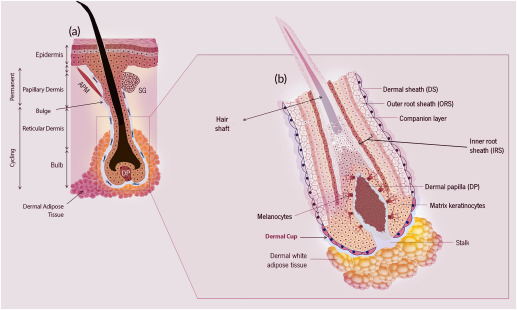
Once your hair grows out of your scalp, it is dead tissue. It cannot “heal” itself or “drink up vitamins” in the way your living skin does.
The outer layer of the hair shaft is made up of microscopic, shingle-like structures called cuticles.
- When cuticles lay flat, your hair feels smooth, shiny, and soft.
- When cuticles are raised or damaged by heat, harsh sulfates, or rough handling, your hair feels rough, tangles easily, and looks dull.
Conventional haircare solves this by coating your hair in silicones (synthetic polymers like Dimethicone). Silicones act like a layer of liquid plastic, forcing the cuticles to lay flat and giving you instant, artificial shine.
Natural haircare does not use synthetic silicones. Instead, it relies on plant fats, natural fatty alcohols, and botanical oils to smooth down the cuticles. This takes a little more time and technique, but the results are real—you’re nourishing the actual strand instead of just wrapping it in plastic.
4. The 4-Part Natural Haircare Stack That Actually Works
You don’t need a shelf packed with fifteen different bottles to have incredible hair. In fact, cluttering your bathroom with too many products usually makes your hair look worse. All you need is a simple, four-part foundational routine.
                     YOUR DAILY NATURAL HAIRCARE STACK

                             SCALP CLEANSE
                       (Mild Sulfate-Free Shampoo)
                                ╱ ╲
                               ╱   ╲
                              ╱     ╲
                             ╱       ╲
                            ╱         ╲
                     MID-LENGTHS ─────── ENDS & SCALP
                    NUTRITION              PROTECTION
               (Botanical Conditioner) (Light Oils & Scrunching)
Step 1: The Wash (Cleansing the Scalp, Not the Ends)
The biggest mistake people make with natural shampoos is expecting them to behave like standard, high-sulfate industrial cleansers.
Conventional shampoos use harsh surfactants like Sodium Lauryl Sulfate (SLS). SLS is the exact same cleaning agent used in heavy-duty dish soap and car wash liquids. It creates massive, billowy clouds of white foam, but it strips away 100% of your scalp’s natural protective oils.
When you switch to a natural, sulfate-free shampoo, look for plant-derived cleansers on the ingredient list, such as:
- Coco-Glucoside
- Decyl Glucoside
- Sodium Cocoyl Isethionate (often derived from coconut)
How to wash like a pro:
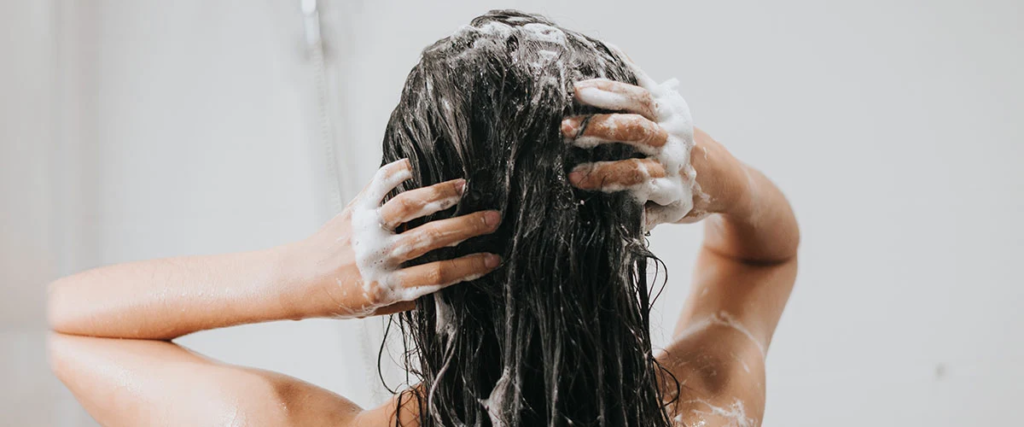
Don’t heap all your hair on top of your head like a shampoo commercial and scrub it into a tangled ball. That creates micro-tears in your hair cuticles.
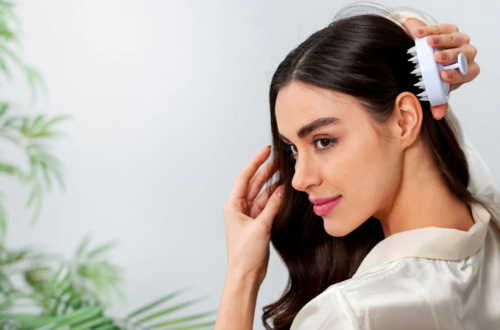
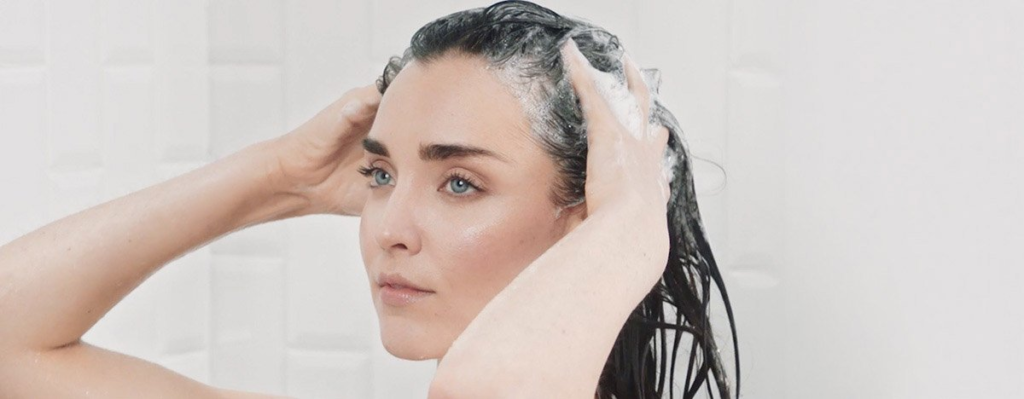
Instead, apply the shampoo only to your wet scalp. Use the soft pads of your fingers (never your sharp fingernails!) to massage your scalp in circular motions for at least 60 seconds. This physically loosens up dirt and oil.
When you rinse, let the soapy water run down through your mid-lengths and ends. That gentle run-off is more than enough to clean the lengths of your hair without drying them out.
Step 2: The Condition (Feeding the Lengths)
Conditioner is completely non-negotiable when you go natural. Because you aren’t using heavy silicones to fake smoothness, your hair needs natural fatty alcohols (like Cetearyl Alcohol) and plant butter to soften the strands and lock in water.
How to condition properly:
Squeeze out excess water from your hair before applying conditioner. If your hair is soaking, dripping wet, the water acts as a barrier, and your expensive botanical conditioner will slide right off into the drain without doing anything.
Apply conditioner starting from your earlobes down to your ends. Keep conditioner away from your scalp unless you have extremely tight, dry coils or an extraordinarily dry head. Let it sit for 2 to 3 minutes while you wash your body, then rinse with lukewarm or cool water.
Pro Tip: Never use scalding hot water to rinse out conditioner. Hot water forces the hair cuticles open, causing instant frizz as soon as your hair dries.
Step 3: The Scalp Support (Targeted, Not Saturated)
Scalp care has become a massive trend, but most people are doing it completely wrong. They pour heavy, viscous oils directly onto their dry scalp, leave it on overnight, and wonder why they wake up with clogged pores and breakout bumps along their hairline.
If your scalp feels tight, dry, or itchy before wash day:
- Choose a light, non-comedogenic carrier oil like Jojoba Oil or Rosehip Seed Oil.
- If you want to use Rosemary essential oil for growth support, mix 2 drops of pure rosemary oil into 1 tablespoon of jojoba oil. Never apply pure essential oil directly to your skin!
- Massage a few drops of this mixture into your scalp 30 minutes before you shower, then wash it out thoroughly with your gentle shampoo.
Step 4: The Drying Phase (Physical Protection)
Here is a cold, hard truth: you can spend hundreds of dollars on organic certified shampoos, but if you treat your wet hair roughly with a bath towel, your hair will snap, break, and look frizzy.
When hair is wet, the internal hydrogen bonds are temporarily broken, making the hair shaft stretchy and incredibly fragile.
- Stop doing this: Do not take a heavy, scratchy bath towel and vigorously rub your hair back and forth like you’re trying to polish a shoe.
- Start doing this: Grab an old, soft 100% cotton T-shirt or a high-density microfiber towel. Wrap it around sections of your hair and gently squeeze the water out.
If you need to detangle wet hair, always apply a tiny drop of leave-in natural oil or leave-in conditioner first. Use a wide-tooth wooden comb or a flexible detangling brush, and start combing from the bottom ends working upwards toward the roots. If you start brushing from the roots down, you push all the small tangles into one massive, tight knot near the bottom, forcing the hair to snap.
5. Tailoring Your Natural Routine to Your Specific Hair Type
There is no such thing as a “universal” haircare routine. What leaves your friend’s thick, curly hair looking bouncy and gorgeous might leave your fine, straight hair looking like a greasy pancake.
                      MATCHING ROUTINES TO HAIR TYPES

       [ FINE / STRAIGHT ]                      [ THICK / CURLY / COARSE ]
  • Lightweight Hydration Only             • Deep Plant Butter & Oils
  • Aloe Vera, Rosewater, Jojoba           • Shea Butter, Argan, Avocado Oil
  • Wash Every 1-2 Days                    • Wash Every 3-7 Days
  • Avoid Heavy Butters & Castor Oil       • Focus on Leave-In Moisture & Definition
Fine or Straight Hair
Fine hair has a small diameter and gets weighed down very easily. Your scalp natural oils travel down straight hair shafts quickly, meaning your roots get oily fast.
- What to look for: Lightweight, water-based hydration. Ingredients like aloe vera juice, chamomile extract, rosewater, and featherlight jojoba oil.
- What to avoid: Raw shea butter, cocoa butter, pure castor oil, and heavy coconut oil.
- Wash cadence: Every 1 to 2 days with a balancing, lightweight natural cleanser.
Wavy & Curly Hair (Types 2 and 3)
Wavy and curly hair cuticles naturally lift at every bend and turn of the curl pattern. This makes it harder for natural scalp oils to travel down the strand, leading to dry, frizzy ends.
- What to look for: Medium-weight moisture, plant protein extracts (like hydrolyzed wheat or quinoa protein) to give curls bounce, and sealing oils like argan or sweet almond oil.
- What to avoid: Harsh alcohol-based styling gels that dry out the curl pattern.
- Wash cadence: Every 3 to 5 days, focusing heavily on conditioning and detangling while wet.
Coarse, Tight-Coiled, or High-Porosity Hair (Type 4)
Coarse and tightly coiled hair requires deep, rich emollient protection to retain moisture and prevent shrinkage and breakage.
- What to look for: Rich plant butters like raw shea, mango butter, and cocoa butter, alongside thick sealing oils like pure castor oil or avocado oil.
- What to avoid: Weak, watery conditioners that don’t provide enough slip for detangling.
- Wash cadence: Every 5 to 7 days, relying on deep conditioning treatments and protective styling to retain length.
6. The DIY Kitchen Nightmares: 4 “Natural” Hacks to Avoid
Social media is full of homemade DIY beauty recipes that promise miraculous results using everyday ingredients from your kitchen pantry. While it feels empowering to mix up your own treatments at home, some of these viral DIY trends can cause genuine damage to your scalp and hair shaft.
                  THE KITCHEN PANTRY DANGER ZONE

    [ DIY TREND ]               [ THE HIDDEN DANGER ]
  • Baking Soda Wash   ──────>  Destroys scalp pH (~9.0 pH) & strips hair
  • Lemon Juice        ──────>  Causes solar acid burns & fries cuticles
  • Raw Egg Masks      ──────>  Proteins too big to absorb + cooks in warm water
  • Straight Essential Oils ─>  Causes severe allergic contact dermatitis
DIY Nightmare 1: Washing Your Hair with Baking Soda
This trend pops up every few years under the name “No-Poo Washing.” Proponents claim that mixing baking soda with water creates a natural, zero-waste cleanser.
Here’s the problem: Baking soda has an extremely high alkaline pH of roughly 9.0. Your scalp’s healthy acid mantle sits at a slightly acidic pH of 5.5.
Washing your head with baking soda is like throwing a chemical bomb at your scalp’s protective barrier. It forces your hair cuticles wide open, strips away every drop of moisture, and leaves your hair feeling like dry straw within a month. Over time, it causes severe hair breakage.
DIY Nightmare 2: Lemon Juice for “Natural” Sun Highlights

Squirting fresh lemon juice onto your hair and sitting out in the sun is a classic teenage summer trope.
It works because citric acid, when combined with ultraviolet sunlight, oxidizes the melanin pigments inside your hair. However, that chemical reaction is completely uncontrolled. It eats away at the structural keratin protein inside your hair shaft, leaving your strands permanently weakened, porous, and prone to snapping off at the slightest touch.
DIY Nightmare 3: Raw Egg Protein Masks
People love whisking raw eggs and slathering them all over their hair for a “natural protein boost.”
The science doesn’t check out: The protein molecules inside a raw egg (mainly ovalbumin) are far too large to actually penetrate the outer cuticle layer of your dead hair shaft. All you are doing is coating your hair in a sticky mess, risking salmonella contamination, and running the risk of accidentally cooking scrambled eggs in your hair if your shower water gets a little too warm.
If your hair needs protein, buy a formulated botanical product containing hydrolyzed plant proteins—these are broken down in a laboratory into tiny micro-molecules that can actually fit inside the hair shaft.
DIY Nightmare 4: Applying Pure Essential Oils Straight to the Scalp
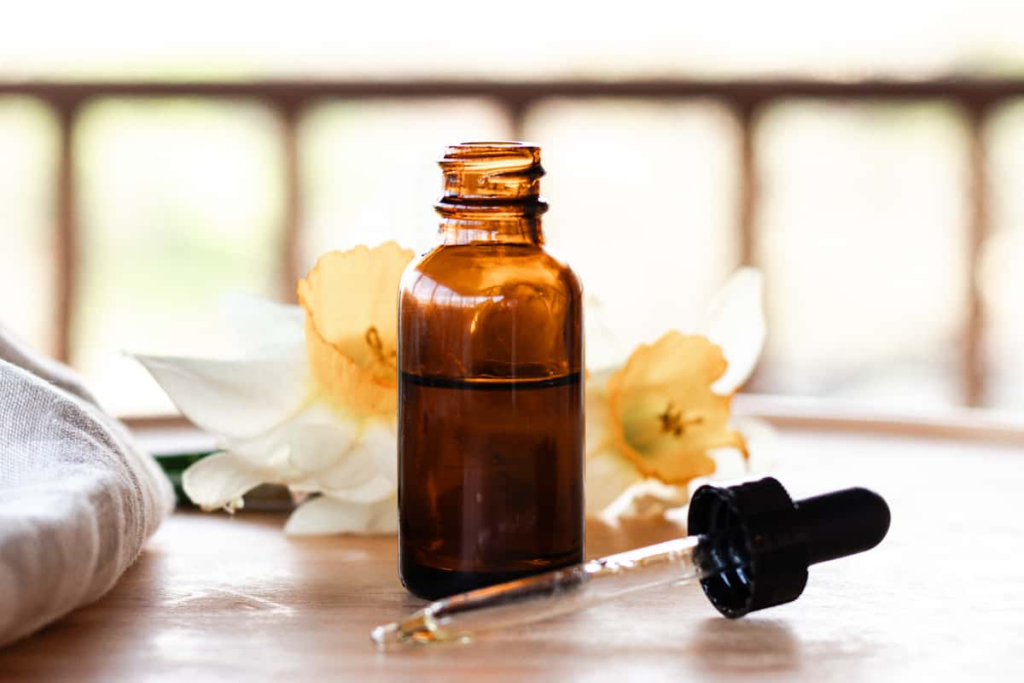
Because essential oils come from plants, people assume they are inherently gentle.
They are not. Essential oils are volatile, extraordinarily concentrated botanical compounds. Applying pure, undiluted tea tree, peppermint, or rosemary essential oil directly onto your scalp skin is a fast track to developing severe contact dermatitis, chemical redness, and long-term skin sensitivity. Always, always dilute essential oils in a gentle carrier oil like jojoba, almond, or squalane before letting them touch your skin.
7. How to Survive the “Detox Phase” Without Giving Up
When you throw away your conventional silicone-heavy shampoos and switch to a natural routine, your hair is going to go through a transition period. This is often called the hair detox phase, and it usually lasts anywhere from 10 to 21 days.
                   THE 3-WEEK NATURAL TRANSITION

  [ WEEK 1: THE SHOCK ]       [ WEEK 2: THE ADJUSTMENT ]   [ WEEK 3: THE BALANCE ]
  • Silicones wash away       • Scalp oil production       • Scalp sebum stabilizes
  • True hair texture shows    begins to equalize          • Cuticles lay flatter naturally
  • Hair may feel rough/dry   • Frizz calms down           • Real shine & softness return
Why Your Hair Might Feel Worse at First
For months or years, conventional products coated your hair strands in a layer of synthetic silicone plastic. This masked the true condition of your hair. If your hair was secretly heat-damaged or dry underneath, the silicone made it feel silky anyway.
When you switch to a mild, sulfate-free natural shampoo, those synthetic coatings gradually wash away, revealing the true, unmasked state of your hair cuticles.
At the same time, your scalp—which was used to being harshly stripped by strong sulfates every few days—might continue over-producing natural oil for a week or two out of habit.
This combination can leave your hair feeling slightly rough, dry, or unusually oily during the first few washes.
How to Get Through It
- Don’t panic: Your hair isn’t falling out or ruining itself. It is simply recalibrating its natural oil production.
- Be consistent: Give your new natural products at least 3 to 4 weeks of continuous use before deciding whether they work for you. Switching products every three days only confuses your scalp further.
- Clarify safely once: If you have massive synthetic product buildup, use a mild, sulfate-free clarifying shampoo during your very first wash to clear the slate without harming your scalp.
Frequently Asked Questions
Is “organic” shampoo really worth the extra money?
Not always. A product being labeled “organic” simply means its plant ingredients were grown without synthetic pesticides. It doesn’t automatically mean the formula is well-balanced for your specific hair type. Focus first on finding a gentle, well-formulated, sulfate-free product that cleanses your scalp comfortably. If it happens to be certified organic as well, that’s a wonderful bonus for the planet.
How do I stop my natural shampoo from leaving my hair feeling tangled?
Natural shampoos lack the synthetic sliding agents that make hair instantly slick under running water. To prevent tangles, make sure you apply shampoo strictly to your roots and massage gently without piling your hair on top of your head. Follow up immediately with a rich, botanical conditioner on your mid-lengths and ends, and gently detangle using a wide-tooth comb while the conditioner is still in your hair.
Can natural oils actually repair split ends permanently?
No, and don’t let any bottle label convince you otherwise. Once a hair strand splits at the end, it is physically separated dead tissue. No oil, butter, or natural extract on Earth can permanently fuse two split ends back together. Oils can temporarily smooth the frayed ends down so they look neater, but the only true, real-world cure for split ends is a clean pair of shears at the hair salon.
How often should I realistically wash my hair with natural products?
There is no golden rule carved in stone. You should wash your hair whenever your scalp feels dirty, oily, or itchy—period. If you exercise daily, live in a hot, humid environment, or have a naturally oily scalp, washing every 1 to 2 days with a mild natural shampoo is completely fine. If you have dry, curly, or coarse hair, washing once or twice a week is usually plenty. Listen to your scalp, not an arbitrary social media calendar.